Why Lusha Can Be Challenging for Indian Companies: What the Data Shows
Lusha's Accuracy Claims vs. the Real Numbers
Lusha is one of the most popular B2B prospecting tools globally. It's especially strong in US and European markets, with a 4.3/5 rating across more than 1,600 G2 reviews. But many Indian sales teams report a different experience. If you've seen higher bounce rates, outdated contacts, or limited coverage outside the major metros, you're not alone. Every claim below is sourced from a public review platform (G2, Capterra, or Trustpilot), linked at the bottom so you can verify it yourself. This isn't about calling Lusha a bad product. It's about giving Indian teams a clear picture before they spend the budget on credits.
Looking for an Indian-first lead generation platform? Explore Leadline by EaseMyExpo
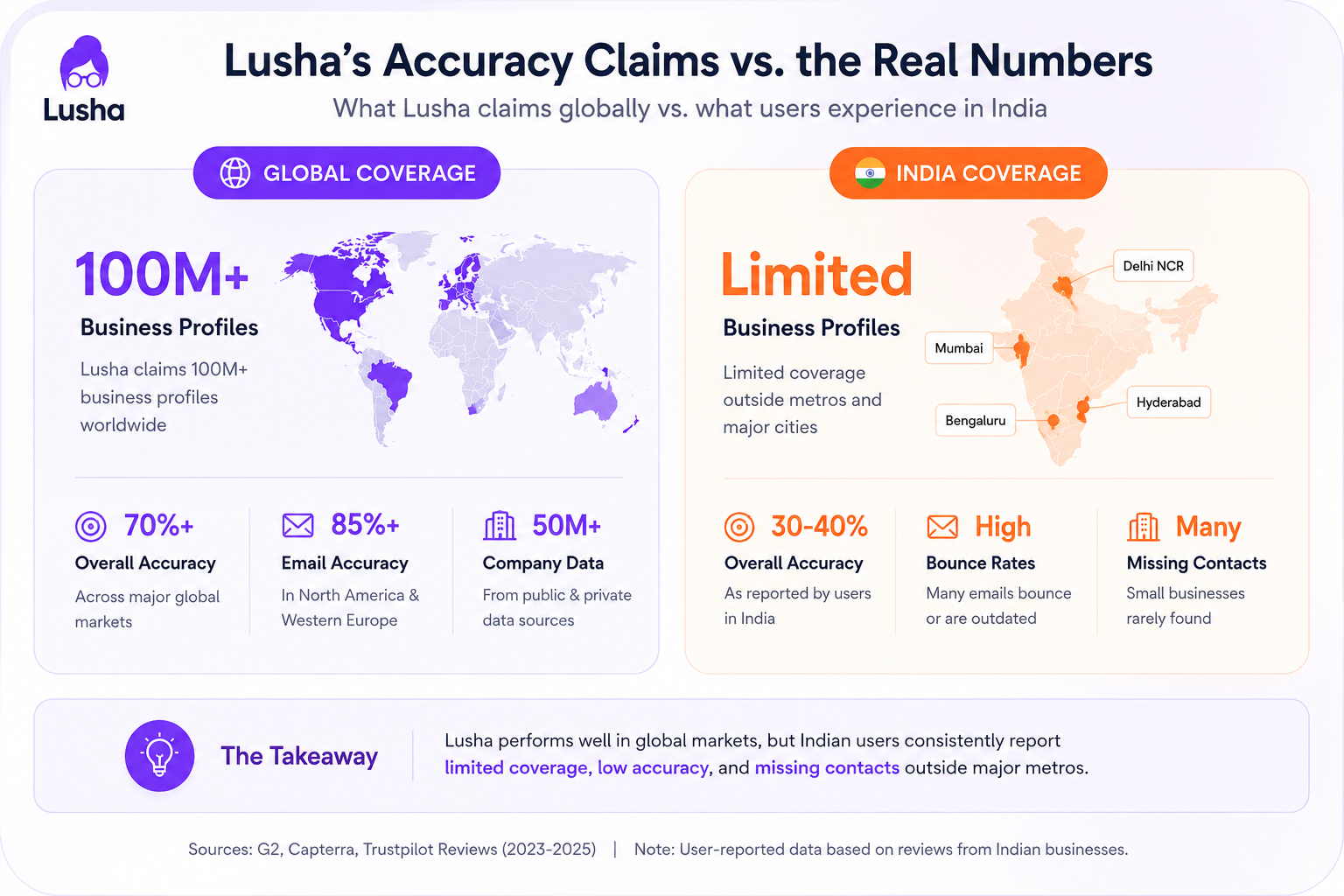
Lusha's Accuracy Claims vs. the Real Numbers
Lusha's marketing cites two headline figures: Email accuracy: around 95% Phone accuracy: around 85 to 90% One independent review roundup, checking these against practitioner feedback, put the real figure closer to 81%. That's still above the 60 to 70% industry average it references. The important caveat: these are all vendor-self-reported numbers, not independently audited. Lusha says as much in its own published materials. That caveat matters more the further you get from Lusha's core markets.
Where Lusha's Coverage Starts to Decline
Three separate review sources point the same direction: SyncGTM's review analysis found Lusha's database is strongest in North America and the UK. Teams prospecting into Europe outside the UK, APAC, or Latin America should expect higher bounce rates and more outdated records. Enrich.so's review found the same split: solid US/UK/Canada accuracy, but weaker continental European and APAC coverage, with more landlines than working mobiles. One G2 reviewer, cited on a competitor's comparison page, reported a bounce rate as high as 30% on invalid emails for outreach lists spanning Europe and Asia. India sits inside "APAC" in every one of these breakdowns. It isn't broken out separately because Lusha's own coverage data doesn't segment it that way.
What Indian Users Are Actually Saying
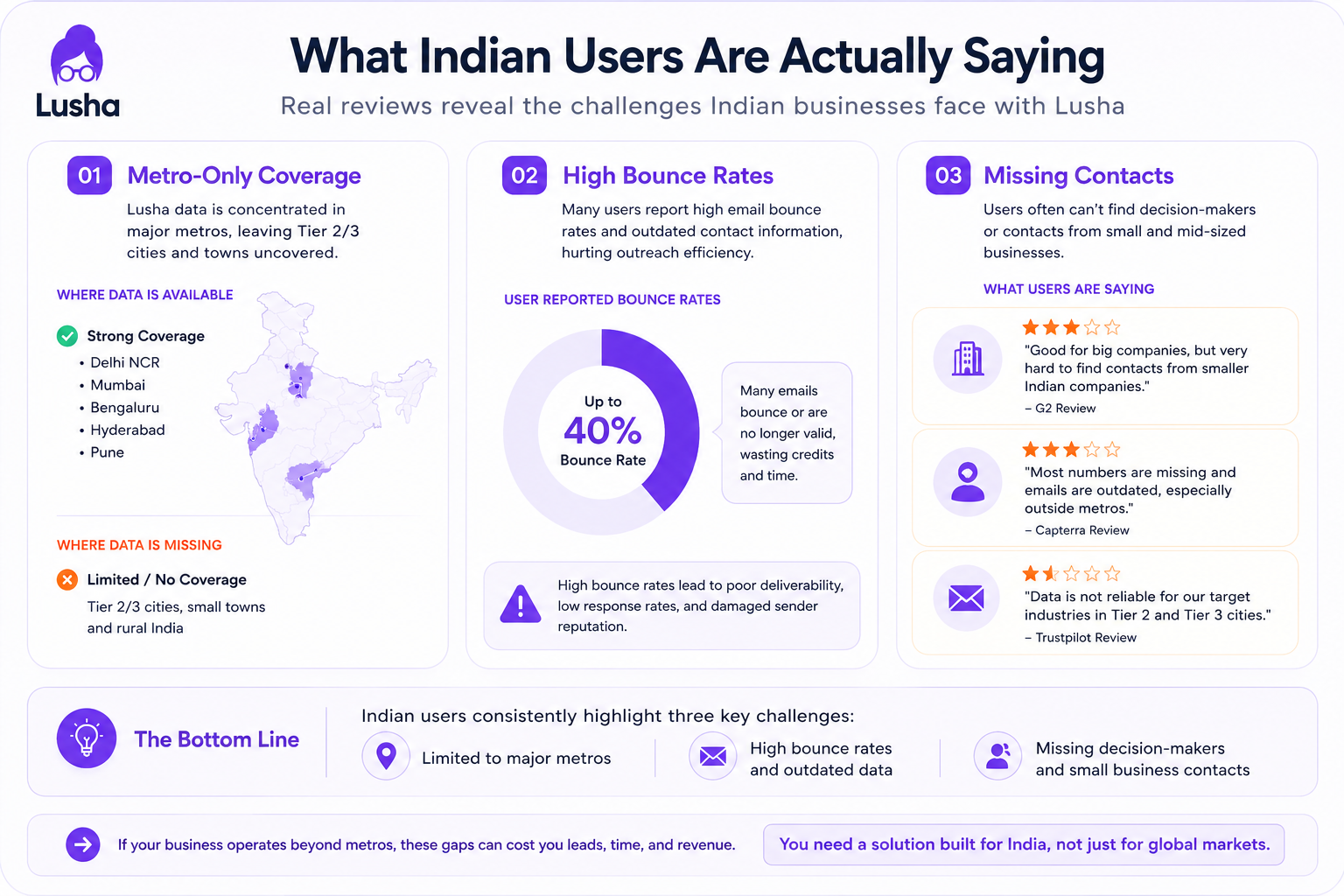
Capterra India collects reviews from Indian business users. Their feedback is sharper than the global APAC numbers above. Geographic Coverage One Capterra India reviewer, testing Lusha across sectors, found contact data missing entirely for: Companies outside India's top metros Smaller cities like Bhopal and Nagpur States like Himachal Pradesh If your ICP isn't confined to Mumbai, Bengaluru, and Delhi NCR, that's a real ceiling on reach. Invalid Email Rates The same reviewer reported roughly a third of pulled contacts had invalid emails. In one test batch, 4 out of 10 picked contacts bounced. Customer Support Another Indian reviewer described emailing Lusha support about an account issue and getting no response at all. Industry-Specific Gaps The same review flagged missing or incorrect contacts specifically in packaging and steel, two sectors with a significant Indian manufacturing base. None of this is cherry-picked from an obscure forum. It's sitting on Capterra's India review page for anyone to read.
The Compliance Gap Nobody Mentions
Lusha markets itself heavily on GDPR and CCPA compliance. Both are US and EU frameworks. India now has its own law: the Digital Personal Data Protection Act, 2023 (DPDP Act). Its substantive obligations are phasing in through May 2027. A few things worth knowing: Nothing in Lusha's public materials specifically addresses DPDP. GDPR compliance doesn't automatically mean DPDP compliance. It's worth asking your compliance team about this now, before a workflow gets built around the tool. This is general information, not legal advice. Check with your own counsel.
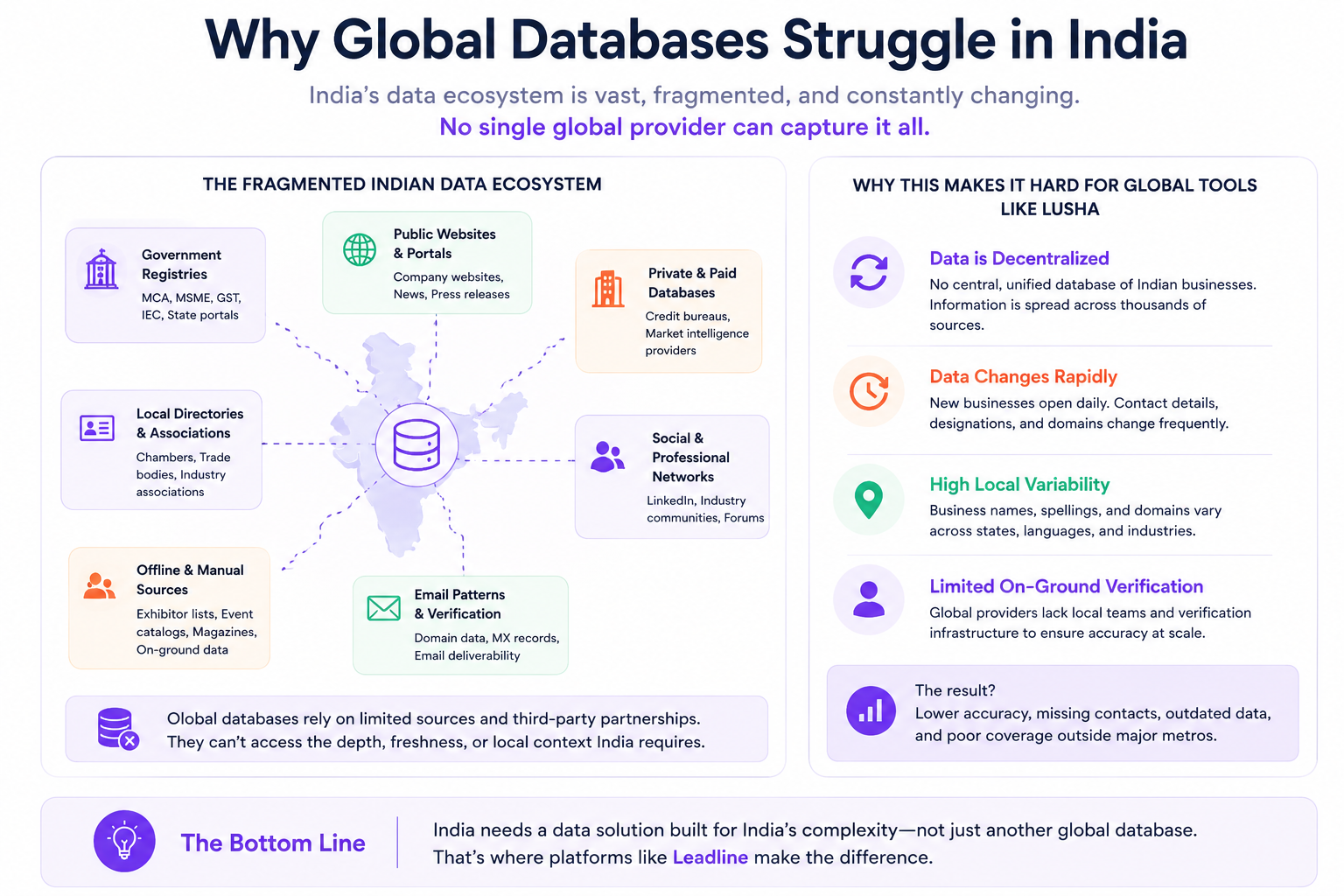
Why Lusha Struggles With Indian Data
This isn't malicious. Every contact database is only as good as its sources, and most global databases lean on the same inputs: Public records LinkedIn activity Corporate email conventions common in Western markets India doesn't map onto that as cleanly: Email conventions vary more widely across companies A large share of India's B2B economy sits outside the top metros Direct-dial mobile numbers are published less consistently than in the US or UK
How to Buy Contact Data for an Indian Pipeline Without Getting Burned
Test before you commit. Pull 30 to 50 contacts against your actual Indian ICP, not a demo list, and check real bounce and connect rates.
- Test before you commit. Pull 30 to 50 contacts against your actual Indian ICP, not a demo list, and check real bounce and connect rates.
- Ask where the gaps are. If your accounts sit outside metro India, or in sectors like manufacturing, packaging, or steel, push for verified numbers there, not blended global stats.
- Don't assume GDPR-compliant means DPDP-compliant. Ask directly and get it in writing.
- Match the tool to the job. A general contact database is a different tool from something built for a specific workflow
See how Leadline verifies trade show contacts in real time
When Your Workflow Starts With a Trade Show, Not a Search Bar
If your workflow starts with exhibitor lists, company directories, or trade show floor plans, Leadline by EaseMyExpo was built specifically for that use case. Instead of relying on a fixed database, it verifies contacts against live mail servers in real time, before you spend a credit. Here's how the two compare for exhibition-specific lead generation:
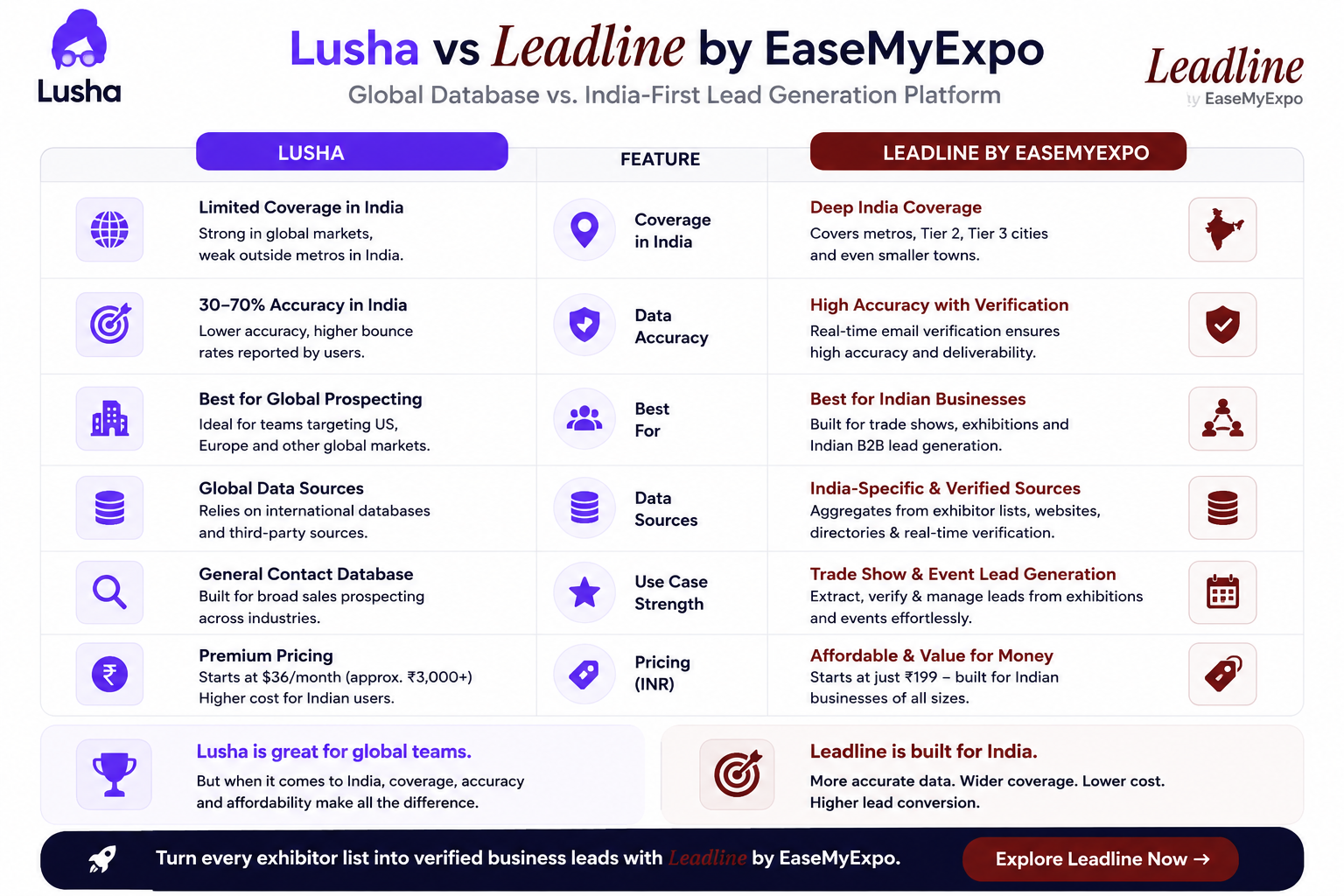
A few links if you want to go deeper:
Learn more about Leadline by EaseMyExpo
Browse upcoming trade shows on EaseMyExpo
Extract leads from exhibitor lists and floor plans
If your bottleneck is a stack of exhibitor PDFs before every show, it's worth a look. If it's general prospecting outside exhibitions, the testing advice above still applies to any provider, Lusha included.
FAQs: Lusha Accuracy in India
Is Lusha accurate for Indian contacts?
Lusha's own accuracy claims (around 95% for email, 85 to 90% for phone) are self-reported and reflect its strongest markets: the US, UK, and Canada. Indian users on Capterra report lower accuracy in practice, including missing data outside major metros and invalid email rates as high as a third in tested samples.
Why does Lusha work better in the US than in India?
Lusha's database is built primarily from Western data sources. India's business landscape, with more varied email formats and a large share of companies outside major metros, doesn't map onto that source data as well.
Does Lusha cover Tier 2 and Tier 3 Indian cities?
Coverage is inconsistent outside major metros like Mumbai, Bengaluru, and Delhi NCR. One Capterra India reviewer specifically flagged missing data for cities like Bhopal and Nagpur, and for Himachal Pradesh
Is Lusha DPDP Act compliant for Indian companies?
Lusha publicly markets GDPR and CCPA compliance but doesn't specifically address India's DPDP Act, 2023. Confirm directly with Lusha and your own legal counsel rather than assuming GDPR coverage extends to it.
What's a good Lusha alternative for Indian trade shows and exhibition leads?
For exhibitor and trade show contacts specifically, Leadline by EaseMyExpo is built for that workflow. For general B2B prospecting outside exhibitions, test any provider against your own Indian ICP before committing.
Final Thoughts
Lusha isn't a scam. Its G2 and Capterra ratings reflect a tool that genuinely works for plenty of people. But "works" is regional. The reviews point the same way from every angle:
- Solid US/UK/Canada accuracy
- Inconsistent APAC accuracy
- Indian users reporting metro-only coverage, higher bounce rates, and slow support
If you're building an Indian pipeline, that's not a rounding error. It's the difference between a list that converts and one that wastes your team's week. Looking at other prospecting platforms? You may also find our comparison on Why Apollo Doesn't Work for Indian Companies useful.