Manual Exhibitor Research vs. Automated Contact Extraction: Which One Is Better?

Last updated: August 25, 2026
There's somewhere right now and a rep is opening a 400 row exhibitor spreadsheet, cracking their knuckles and telling themselves that this is going to be quick and easy.. It never goes fast. By row 40 the coffee's cold, by row 200 the guessed email formats start looking suspiciously like wishful thinking, and by the time the list is "done," half the show floor has already changed jobs. If you've lived this, you already know the real question isn't whether to research exhibitors, it's whether a human grinds through it row by row or software does it while you do literally anything else.
Here's the honest version of that comparison, not the "automation wins, obviously" version, because plenty of teams have gotten burned going all-in on either side.
Quick answer:
- Automation wins on speed, scale, and data accuracy for any exhibitor list bigger than a handful of companies
- Manual research earns its keep on a short list of high-value accounts where a rep's judgment beats raw speed
- Most teams don't pick one, they blend both and let the size of the list decide the split
What manual exhibitor research actually looks like
Someone opens the exhibitor list, picks a company, and starts hunting: Google the name, check the website's team page, search LinkedIn for the right title, guess an email format. Repeat 400 times. Somewhere around company 150 you start bargaining with yourself about whether "probably still works there" counts as verified.
It works, technically. It's just slow, and it gets slower the further down the list you go. Prospecting research already eats close to a tenth of a rep's working week, and B2B reps tend to run higher than that average. Do the math on a 400-company floor plan and you're looking at a full week of research before a single outreach email goes out, assuming nothing on the list changes in the meantime. Spoiler: it will.
Source: SPOTIO's 2026 field sales statistics roundup
Where automated contact extraction quietly changes the math
Automated extraction starts from the same place, a company name, a directory URL, a floor plan, but instead of a person doing the digging, software matches it against live company data and verifies emails against mail servers before handing anything back. What comes out is a name, a role, a checked email, and a phone number, not a guess someone made at 4pm on a Thursday because they wanted to go home.
The real difference shows up at row 340, not row 1. That's where a tired researcher starts cutting corners without meaning to. The software performs the same test for row 340 as it does for row 1 and can test the entire list the week of the show or test it again based on a previous research by someone a month before. This is what a tool such as Leadline is designed to fill.
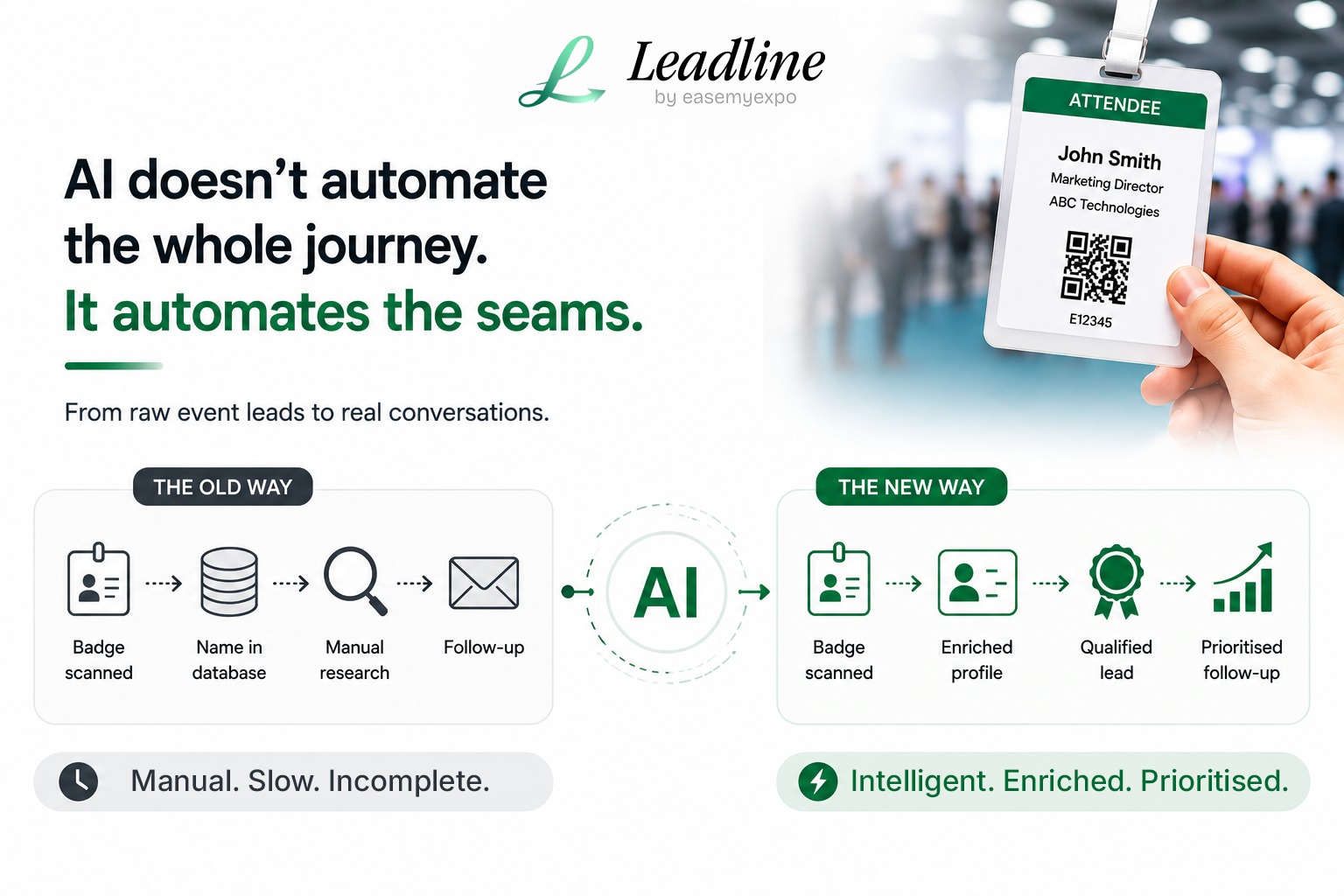
Manual vs. automated: the actual head-to-head
- Time — A 50-company manual pass takes about a week. Automated extraction handles it in minutes to a few hours, and the gap widens as the list grows.
- Accuracy — Manual research is only as good as the researcher's guesswork on the day they looked. Automated tools verify against live mail servers before delivery, so bounced-email surprises drop off.
- Judgment calls — Picking the right contact out of three plausible people at one company still leans human. No tool fully owns that yet, and honestly, that's the one place software should stay out of the way.
- Freshness — A manually researched list is a snapshot from whenever someone did the work, and it goes stale fast. Contact data decays around 22.5% a year on the conservative end, mostly from people changing jobs, so a list built weeks out is already partly wrong by show day
Picking your default: five accounts vs. five hundred
If it's five strategic accounts you already know well, a rep who reads the company's recent news and picks the right person to approach is doing something software can't fully replace yet. That's a real strength, not a consolation prize.
Read more: How to find decision-makers at a company
If it's fifty-plus companies with a hard deadline before doors open, which describes most exhibitor lists, automation is the better default and it isn't close. Most teams end up running automation for the bulk of the list and saving a rep's actual research time for the accounts big enough to justify it. That's the whole idea behind Leadline: paste a directory URL, upload a floor plan, or drop in company names, and get back verified emails, direct phones, and decision-maker names, so time goes toward talking to people instead of hunting for them.
See it in action: DairyTech India 2026 exhibitor list guide
FAQ
Is manual research ever more accurate than automation?
Rarely on raw data. A skilled researcher can nail one well-known contact, but automated verification catches bounced emails a manual guess won't. Manual research wins on judgment calls, not accuracy.
Does automated contact extraction cost more than a rep's time?
Usually the opposite. Price a rep's hourly rate against a week of manual research for one show, and it's not close.
Can automation read a PDF or a photo of a floor plan?
Yes. That's actually one of the hardest things to do by hand, since typing booth numbers off a floor plan image is its own special misery.
Do I still need a human review after automated extraction?
For your top accounts, yes, a quick pass is worth it. For the bulk of a large list, most teams trust the tool's verification and skip it.
This article reflects general industry research and Leadline's product approach as of August 2026. Figures on research time and data decay vary by source; treat them as directional benchmarks.