How to Prove ROI to Exhibitors After Your Exhibition Ends
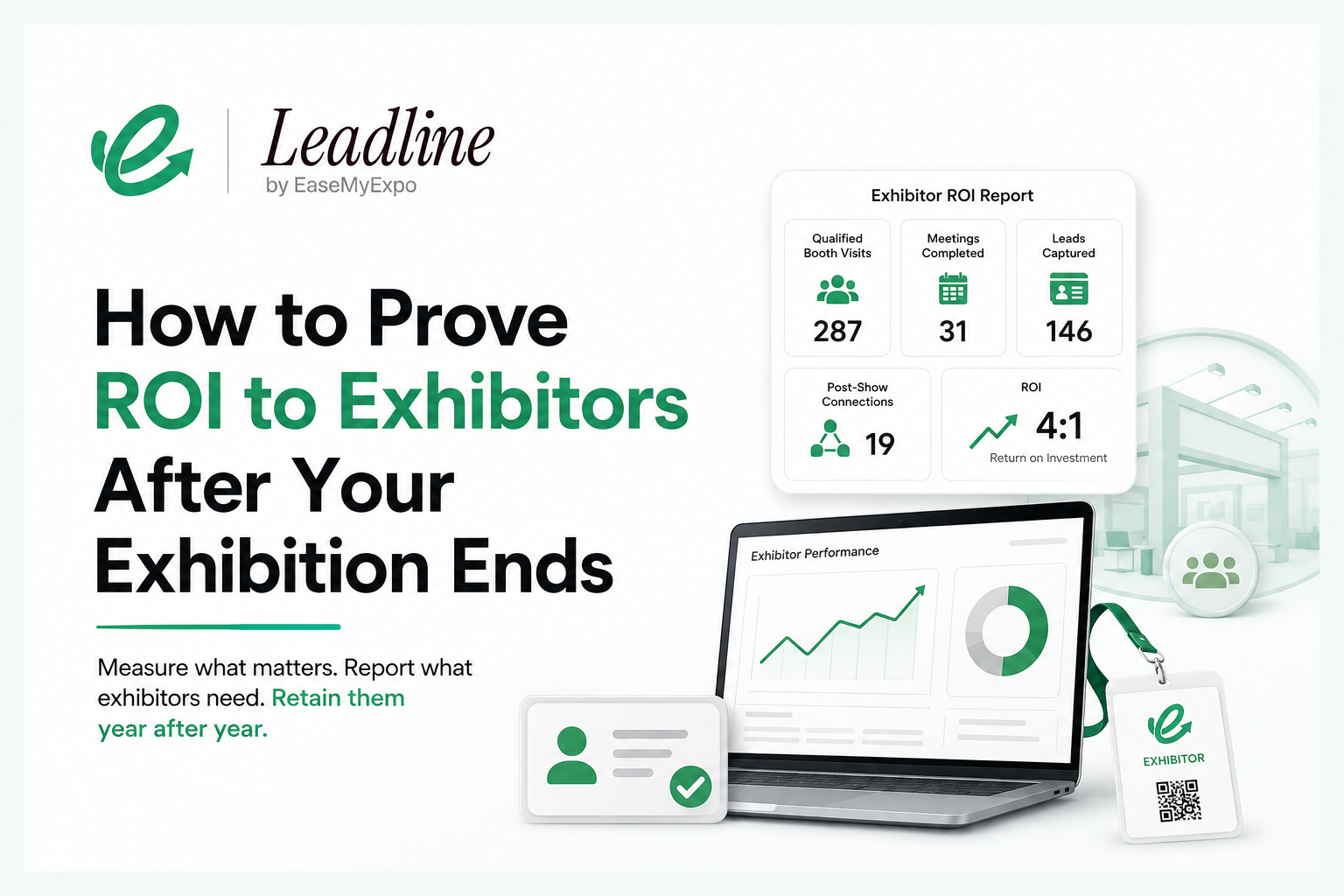
"Was it worth it?"
That is the question every exhibitor takes back to their team after the show closes. And whether they get a yes or a no determines whether your rebooking call next quarter is easy or impossible.
Only 49% of exhibitors formally measure trade show ROI. The other half cannot prove what their participation was worth, not because the show did not deliver, but because the data was never captured in a form they could use internally.
This is a solvable problem. But it is the organiser who has to solve it.
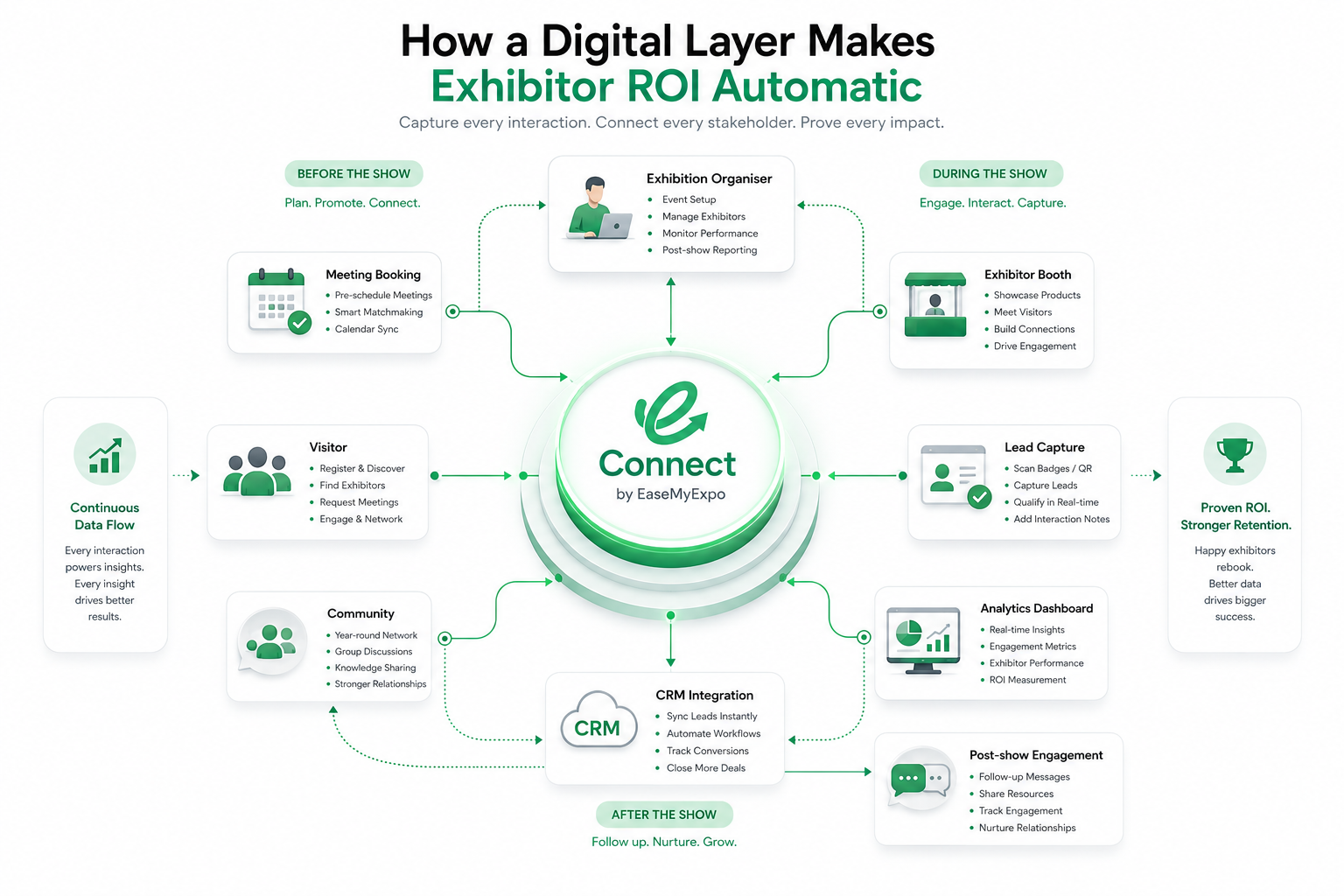
This guide explains exactly what exhibitors need to see after the show, why footfall reports are not enough, what data you should be capturing, and how a digital layer around your event makes proving exhibitor ROI automatic rather than painful.
Discover Connect by EaseMyExpo for exhibition organisers
Quick Answer: How Can Exhibition Organisers Prove ROI to Exhibitors?
The most effective way is to measure more than footfall. Organisers should track and report:
- Qualified booth visits (not just total venue footfall)
- Meetings booked and completed before and during the show
- Leads captured with role and company detail, not just badge scans
- Follow-up activity between exhibitors and their show contacts
- Post-show engagement showing connections that continued after closing day
- Year-on-year exhibitor performance comparison
A digital exhibition platform makes this reporting automatic and significantly improves exhibitor retention without requiring manual data assembly after every show.
What Is Exhibition ROI? (Definition)
Exhibition ROI is the measurable business value an exhibitor receives from participating in a trade show, including qualified leads generated, meetings completed, pipeline created, sales opportunities opened, and long-term business relationships formed, compared to the total cost of exhibiting.
The formula most exhibitors use:
Exhibition ROI = (Revenue from event leads minus total participation cost) divided by total participation cost, expressed as a percentage.
A 4:1 return, meaning four rupees generated for every one rupee spent, is the average benchmark reported by exhibitors across the trade show industry. However, most exhibitors cannot calculate this clearly because the data needed to complete the formula is never systematically captured.
UFI Global Exhibition Industry Association
Why Exhibitors Keep Asking About ROI (and Why Your Current Answer Is Not Working)
The conversation goes the same way at most exhibitions after the show closes.
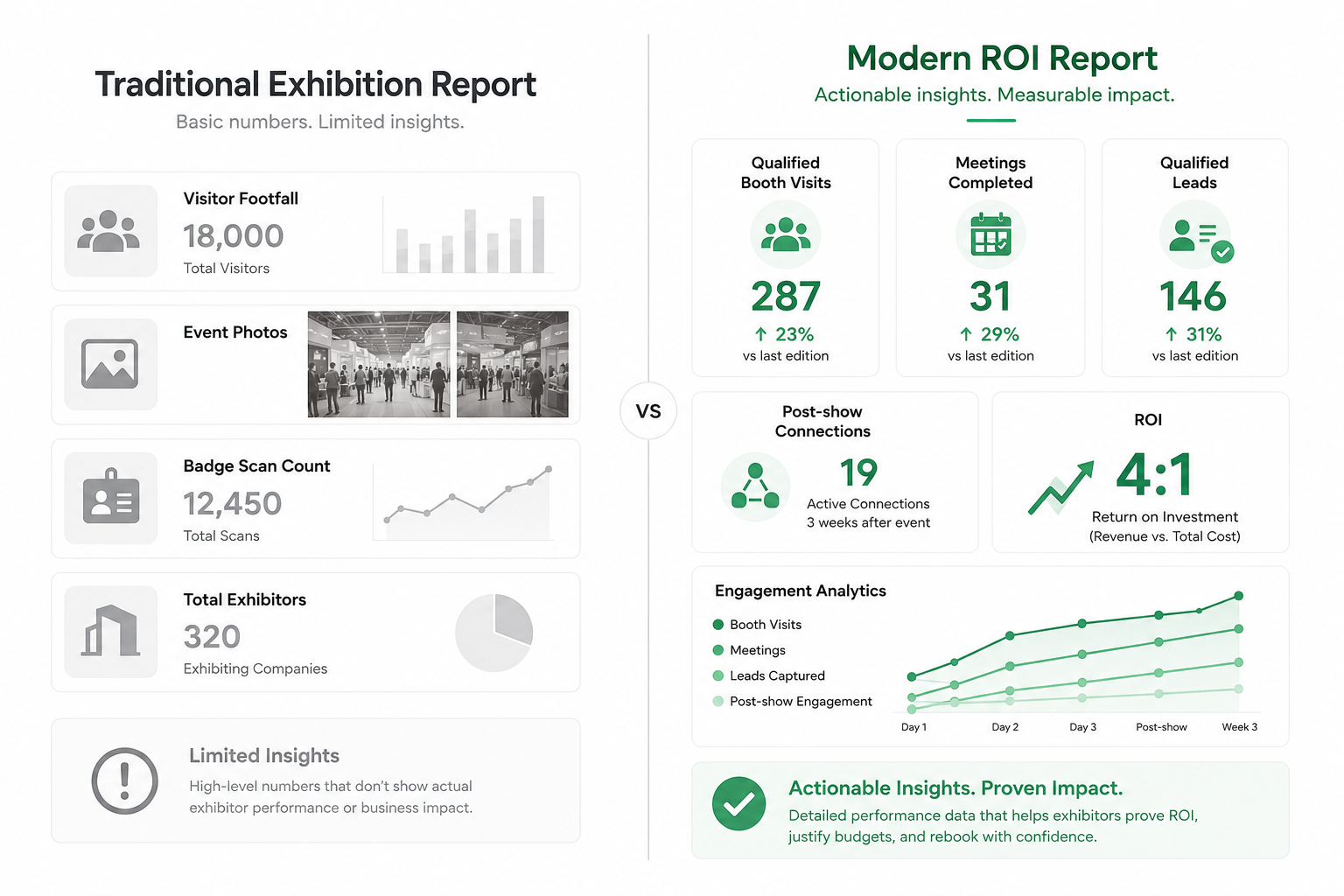
The organiser sends a summary report with total visitor footfall, total exhibitors, and photographs from the floor. The exhibitor shares it internally. Someone in finance or senior leadership asks how many leads came in, how many converted, and what the return was on the eight lakh spent on the stall.
The exhibitor has no clear answer. Not because the show was bad. Because the right data was never captured.
Here is the specific pressure exhibitors are under right now:
- 75% of exhibitors face organisational pressure to reduce costs
- 52% of business leaders identify trade shows as the highest-ROI marketing channel
- But when pressed for proof, most exhibitors are working from badge scans and a general sense that the booth felt busy
The exhibitors who renew consistently are the ones who can walk into a budget meeting and say: "We had 287 qualified booth interactions. We completed 31 meetings. 19 of those connections are still active on the platform three weeks later."
The exhibitors who do not renew are the ones who cannot say anything like that.
Whether your show actually delivered for them matters less than whether they can prove it delivered.
Explore Leadline by EaseMyExpo for pre-show lead generation
Browse upcoming exhibitions: Leadline Tradeshow Calendar
Traditional Reporting vs Modern Exhibitor ROI Reporting
Most exhibitions are still sending traditional post-show reports. Here is the difference between what organisers typically provide and what exhibitors actually need.The difference is not cosmetic. It is the difference between an exhibitor who can defend their show budget internally and one who cannot.
What Exhibitors Actually Want to See After the Show
Footfall is a vanity metric for exhibitors. They already know how many people came to the venue. What they need is proof that the show generated real business activity.
Here is what exhibitors actually want in a post-show ROI report:
Booth-level interaction data
- How many visitors stopped at their specific stall
- Average interaction time per visitor
- Which product categories drove the most engagement
Lead quality breakdown
- Not just volume of leads but quality
- Split by job title and seniority
- Split by company size and industry
- Percentage that match their ideal buyer profile
Meetings completed vs meetings booked
- How many pre-booked meetings were completed
- How many walk-in conversations progressed into structured follow-ups
- No-show rate and reasons where captured
Connections that continued after the show
- How many of their show contacts stayed active on the platform
- Follow-up message activity between exhibitors and their contacts
- Connections from this year versus last year
Year-on-year comparison
- Was this edition better than last year for this specific exhibitor
- How did their booth performance compare to the show average
- What percentage of their leads were new versus returning contacts
Related: How Exhibition Organisers Can Build a Digital Ecosystem
What Data Points Organisers Should Be Capturing
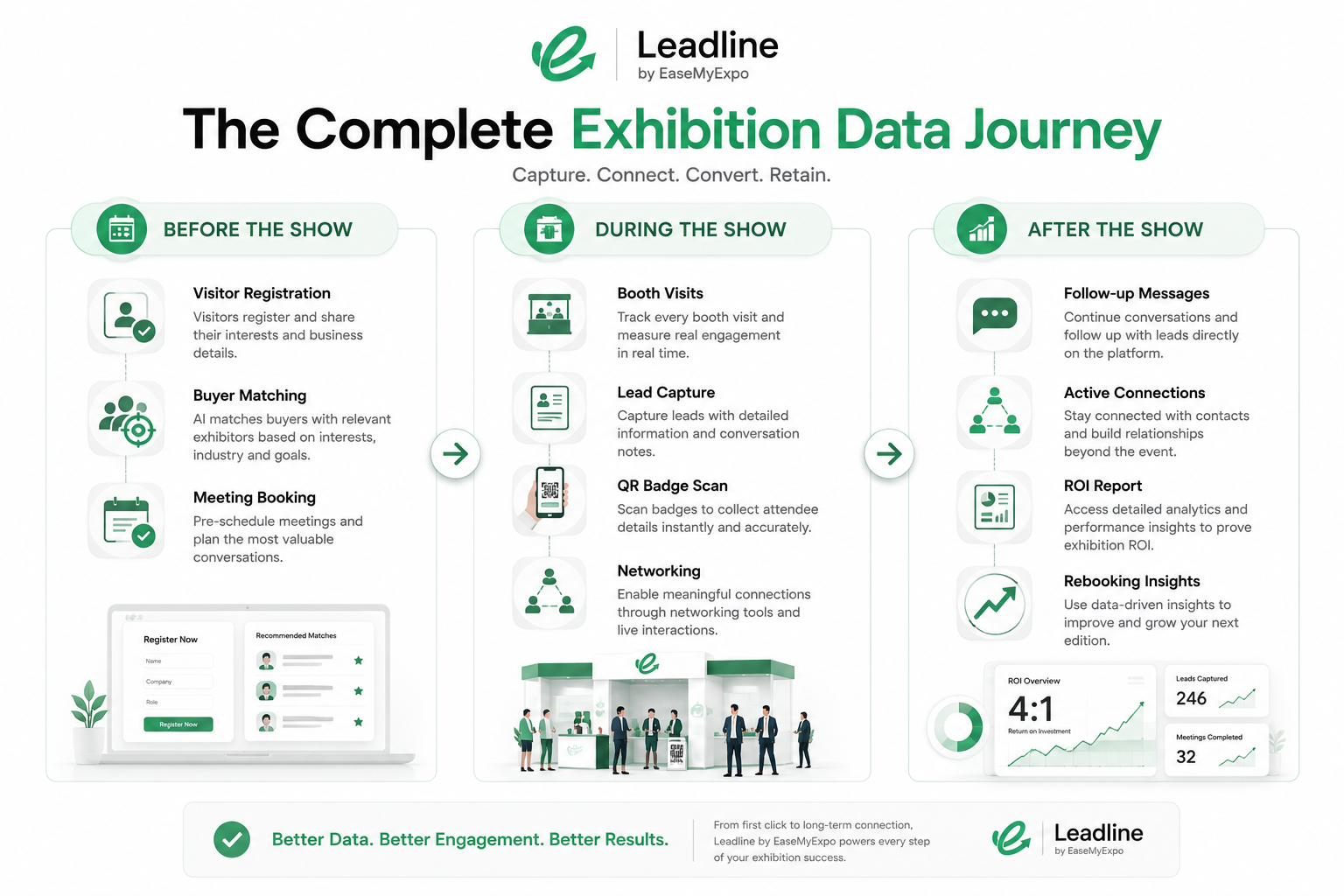
Most organisers capture footfall at the entry gate and almost nothing else. Here is the complete list of data points that create a genuinely useful exhibitor ROI report.
Before the show:
- Registered visitors matching each exhibitor's industry and buyer profile
- Visitor interest tags relevant to each exhibitor's product category
- Pre-show meeting requests initiated between visitors and exhibitors
During the show:
- Booth-level visit counts and interaction time
- Lead capture activity including name, role, company, and interaction notes
- Meetings completed from pre-booked slots
- Spontaneous connections made through platform networking tools
- Live event activity including exhibitor posts and visitor engagement
After the show:
- Connections that continued post-event through the platform's community layer
- Follow-up message activity between exhibitors and show contacts
- Lead progression from initial contact to follow-up conversation
- Exhibitor satisfaction data collected within 48 hours of closing
The challenge is that most of this data does not exist if the only tools at your show are a registration system and badge scanners. A digital ecosystem layer around your show is what makes this data capturable automatically.
Leadline Pricing: Start free with Leadline by EaseMyExpo
Why Footfall Numbers Alone Do Not Satisfy Exhibitors
Footfall tells an exhibitor how many people came to the venue. It does not tell them whether any of those people were relevant to their business. It does not tell them how many stopped at their specific booth. It does not tell them what happened in the conversations that took place.
Think about what an exhibitor is actually trying to prove internally. Their budget holder wants to know whether the eight lakh spent on the stall produced pipeline.
"The show had 18,000 visitors" does not answer that question.
"Your stall had 287 qualified interactions. You completed 31 of your 34 pre-booked meetings. 19 of your show connections are still active on the platform" does. The difference between those two sentences is the difference between an easy rebooking conversation and a difficult one.
Exhibitors who face pressure to cut marketing budgets cut the channels they cannot defend with data first. If your show cannot provide data beyond footfall, it is vulnerable to being cut regardless of how good the experience felt on the floor.
How Do Exhibitors Calculate Exhibition ROI?
This is the question exhibitors are trying to answer when they ask you for data after the show. Understanding their calculation helps you give them exactly what they need.
The basic calculation:
Exhibition ROI = (Revenue generated from show leads minus total exhibition cost) divided by total exhibition cost multiplied by 100
For a typical exhibitor, total exhibition cost includes:
- Stall rental (shell scheme or bare space)
- Stall design and fabrication
- Travel and accommodation for the team
- Promotional materials and giveaways
- Staff time during preparation and the show
For an exhibitor who spent eight lakh total and generated forty lakh in revenue from show leads, the ROI is 400%. A 4:1 return is the industry average benchmark.
The problem is that most exhibitors cannot complete this calculation. They know the cost. They cannot reliably attribute revenue because they never set up proper lead tracking during the show. That is the organisational failure the organiser can prevent by providing better data infrastructure.
Related: How to Generate Leads Before a Trade Show
Why Do Exhibitors Stop Rebooking? The Real Reasons
Most organisers assume exhibitors leave because a competitor show offered a better deal or the venue was inconvenient. The data tells a different story.
The primary reasons exhibitors do not rebook:
- They cannot prove the show delivered enough to justify the budget
- Their internal approval process requires ROI data they do not have
- The organiser's post-show report did not give them anything defensible to share internally
- They felt the show attracted the wrong visitor profile for their product
- The follow-up experience after the show left them feeling disconnected from their contacts
Notice that most of these are data and communication problems, not show quality problems. An organiser who solves the data problem removes the most common reason exhibitors do not rebook, regardless of how good or bad the show actually was.
How Can Organisers Improve Exhibitor Retention?
This is the practical question that follows from everything above. Here is what to put in place before your next edition.
- Set up pre-show meeting booking Every meeting booked before the show is a data point. Pre-booked meetings have higher completion rates than walk-in conversations, and completed meetings are among the strongest signals of exhibitor ROI. Organisers who facilitate this get better data and better exhibitor outcomes simultaneously.
- Give exhibitors a lead capture tool they own Badge scanners that lock data into the organiser's system are not enough. Exhibitors need to own their leads and export them to their own CRM. Lead ownership is the foundation of any ROI conversation. An exhibitor who owns 40 qualified contacts from your show has a reason to rebook. An exhibitor whose leads sit in your vendor's system does not.
- Create a post-event community layer The connections that continue after the show are the most valuable ROI evidence you can provide. If your platform keeps exhibitors and visitors connected after closing day, you can show exhibitors how active their show network remained in the weeks and months after the event. That continuity is the strongest retention mechanism available to an organiser.
- Build the ROI report into your platform A report assembled manually from three different systems is slow and incomplete. When the data captures itself through a connected platform, the report is ready before you even make the rebooking call.
See how Connect by EaseMyExpo works: EaseMyExpo
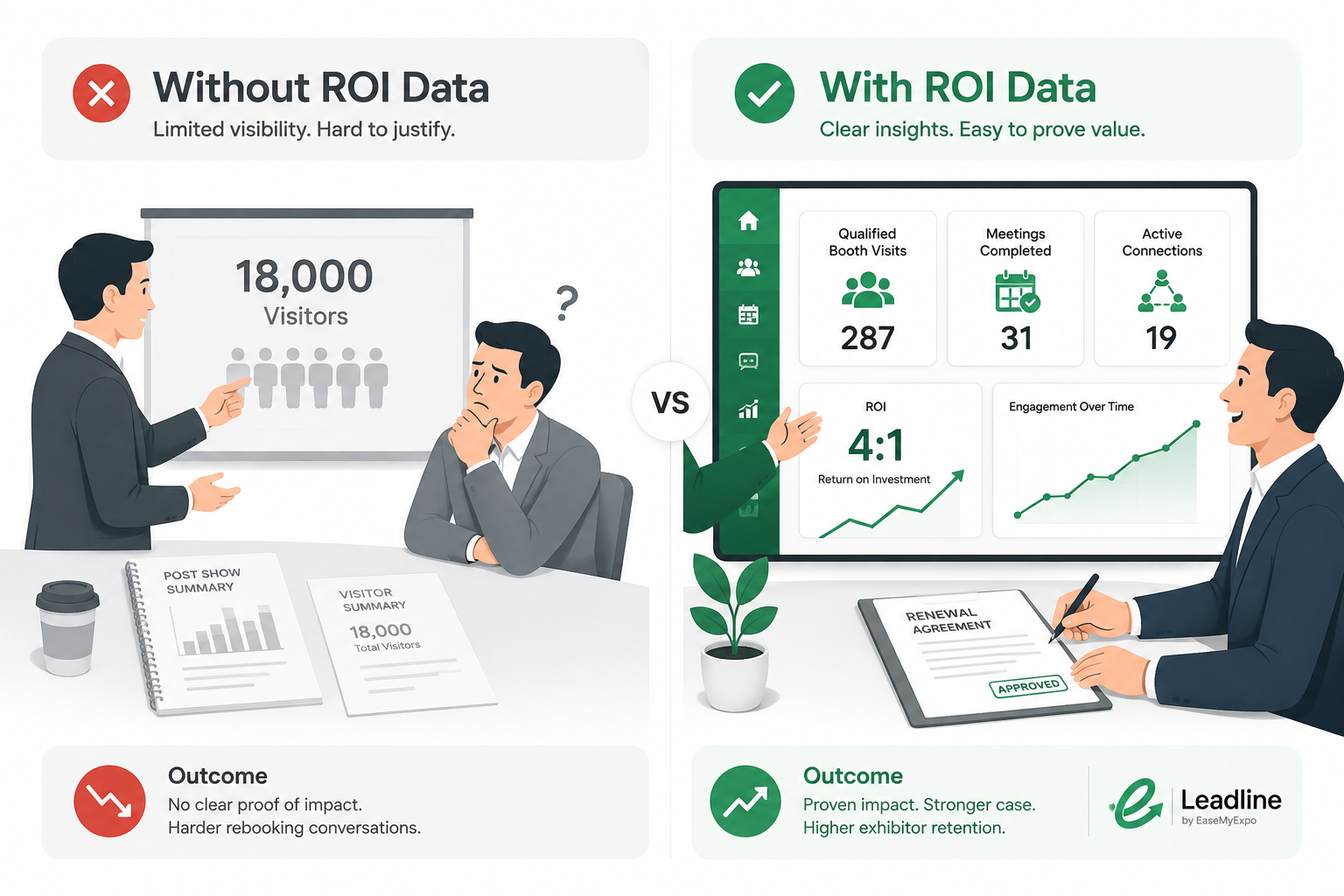
The Rebooking Conversation: With Data vs Without
Here is what the rebooking conversation looks like when you have exhibitor ROI data versus when you do not.
Without data:
Organiser: "We had 18,000 visitors this year, up 12% from last year. Would you like to rebook for the next edition?"
Exhibitor: "We are not sure it performed well enough. Let us see how the leads convert before we decide."
This conversation happens in January. The show is in August. Seven months of uncertainty.
With data:
Organiser: "Here is your post-show exhibitor report. Your stall had 287 qualified interactions. You completed 31 of your 34 pre-booked meetings. 19 of your show connections are still active on the platform. Compared to last year, your interaction count was up 23%. Would you like to rebook at the same location or upgrade?"
Exhibitor: "Let us upgrade. What is the next size available?"
The data does not just make the case for your show. It makes the exhibitor's internal case for you.
Frequently Asked Questions About Exhibition ROI for Exhibitors
How can exhibition organisers prove ROI to exhibitors?
By providing data beyond footfall. The most useful post-show exhibitor ROI report includes qualified booth visit counts, meetings booked and completed, leads captured with role and company context, post-show connection activity, and year-on-year comparison. A digital exhibition platform makes this data available automatically without manual assembly.
What is a good exhibition ROI for exhibitors?
The industry benchmark reported across trade show research is a 4:1 return, meaning four rupees generated for every one rupee invested in exhibition participation. High-performing exhibitors at well-run shows report ROI of 5:1 or above. However, the more important metric for most exhibitors is whether they can demonstrate any measurable return, since 51% currently cannot.
Why do exhibitors fail to measure ROI?
Primarily because the data infrastructure was never in place. Badge scanners capture who attended the venue, not who interacted with a specific booth. Business cards go into bags with no follow-up system. Post-show email outreach is not tagged back to the show. The organiser has no way to report on individual exhibitor performance. The result is that exhibitors know what they spent but cannot reliably attribute what they earned.
How do exhibitors justify exhibition budgets internally?
With qualified lead counts, meeting completion data, and evidence of ongoing business conversations after the show. An exhibitor who can show their budget holder 287 booth interactions, 31 completed meetings, and 14 active post-show conversations has a defensible case for continued participation. An exhibitor working from a badge scan count and a folder of brochures does not.
Why do exhibitors stop rebooking?
The primary reason is inability to prove internal ROI. Secondary reasons include irrelevant visitor profiles and poor post-show follow-up infrastructure. All three are problems the organiser can address with better data capture and reporting tools.
What is the connection between exhibitor data and rebooking rates?
Direct and measurable. Exhibitors who can prove ROI renewal. Exhibitors who cannot tend not to. This is not primarily about whether the show actually delivered. It is about whether the exhibitor has the data to prove internally that it was delivered. Organisers who provide that data remove the biggest friction point in the rebooking conversation.
What is exhibitor engagement data?
Exhibitor engagement data is the set of measurable interactions an exhibitor has with visitors before, during, and after an exhibition. It includes booth visit counts, lead captures, meeting bookings and completions, post-show connection activity, and follow-up message volume. This data, when provided by the organiser, is what allows exhibitors to quantify their return on participation.
Explore Connect by EaseMyExpo: EaseMyExpo
Explore Leadline for verified exhibitor contacts: Leadline by EaseMyExpo
People Also Ask
Is footfall enough to prove exhibition ROI?
No. Footfall tells exhibitors how many people came to the venue, not how many were relevant buyers, not how many stopped at their booth, and not what happened in those conversations. Exhibitors need qualified booth visits, lead quality data, meetings completed, and post-show connection activity to make a credible internal case for continued participation.
What makes exhibitors renew their participation?
The ability to prove a measurable return. Clear ROI data, evidence of quality visitor interactions, completed meetings, and post-show business opportunities all contribute to the renewal decision. Organisers who provide this data remove the primary reason exhibitors do not rebook.
Why do exhibitors leave exhibitions?
Poor ROI visibility is the most common reason. Exhibitors also cite irrelevant visitor profiles, weak follow-up infrastructure after the show, and inability to own and export their leads. All of these are organiser-level problems with organiser-level solutions.
What is the difference between exhibitor data and visitor data?
Visitor data covers aggregate attendance, registration profiles, and overall footfall. Exhibitor data is granular to each participating company and shows booth-level interaction quality, lead capture volume and quality, meetings completed, and post-show engagement. Exhibitor data is what proves ROI. Visitor data is what sells the show to new exhibitors.
Browse all upcoming shows: Leadline Tradeshow Calendar
The Shows That Win Rebooking Conversations Start Capturing Data Today
The exhibition industry is more competitive than it has been at any previous point. Exhibitors are under budget pressure. The shows that keep filling booths year after year are the ones that remove the guesswork from the rebooking conversation.
Footfall reports were enough when the show was the only option in town. They are not enough now.
The exhibitions that grow over the next decade are the ones where exhibitors leave every edition with a clear picture of what they received, a report they can defend internally, and a network that is still generating value when the organiser calls to rebook.
Want to help your exhibitors prove ROI automatically?
A digital networking layer turns every booth interaction, every meeting, and every post-show connection into measurable business value your exhibitors can report on.