How to Find Decision-Maker Contacts Without Paying for an Entire Database
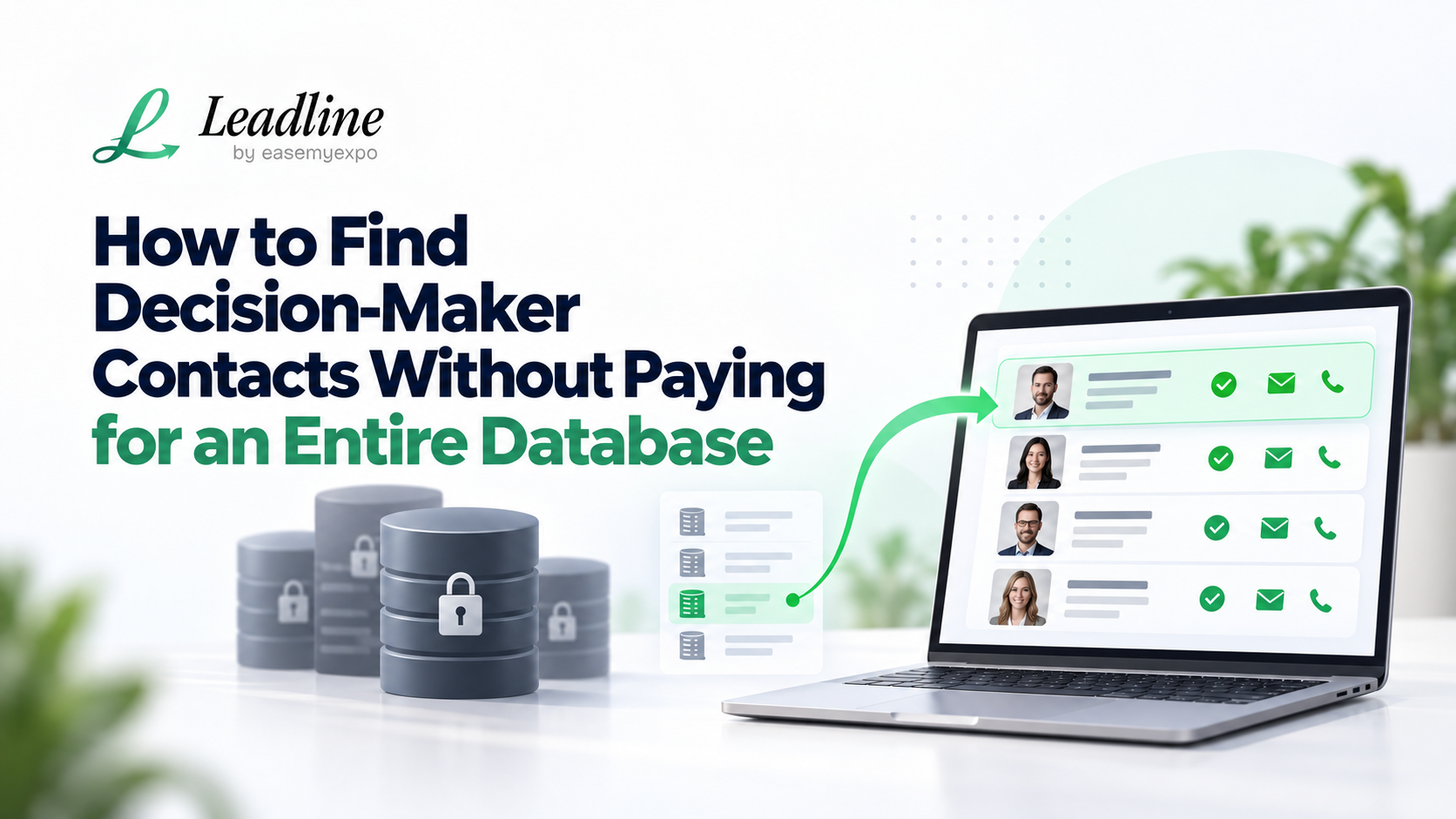
You don't need a database subscription to find decision-maker contacts. For a handful of companies, free public sources will get you there on their own. For anything at volume, a pay-per-result tool gets you the same result without the yearly seat fee sitting underneath it.
That second option is worth naming upfront, because it's the part most guides on this topic skip. Leadline is one example, built specifically for exhibitions, and it comes up a few times below because the exhibitor-list problem is a genuinely different shape than general B2B prospecting.
Here's how to handle both cases, and where each one runs out of road.
Why decision-maker databases cost so much
Apollo starts around $49 a month. ZoomInfo-style contracts run closer to $15,000 a year, often with a multi-year commitment attached. LinkedIn Sales Navigator sits around $99 a month.
None of that price tag is really about the five contacts you need this week. It's about maintaining access to millions of records you'll open maybe a dozen times a year, kept current by a team that has to chase job changes and dead numbers every single month.
That upkeep is the real cost driver. Contact data goes stale fast, since people switch jobs, get promoted, and change numbers constantly, and a database that isn't re-verified turns into a list that bounces.
See what a pay-per-result model looks like instead
What you're actually paying for when you buy the whole database
Three things, mostly, and none of them are the search itself.
Coverage you won't use
You need marketing directors at manufacturing firms in Mumbai. Full database access includes finance VPs in German logistics companies too, and you pay for both.
A search engine, not a guarantee
Even the largest databases miss people. Founders at small companies and regional operators, anyone who doesn't keep a polished LinkedIn profile, are often missing or badly outdated. You can pay full price and still strike out on your actual target list.
A commitment, not a transaction
Annual contracts assume ongoing need. If your real need is one campaign, or one trade show, you're locking into twelve months to solve a problem that lasts two weeks.
Free ways to find decision-maker contacts
For small, one-off searches, these cost nothing but your time. They're also the right starting point even if you end up paying for something later.
Company websites
The "Leadership" or "Our Team" page usually names the people running the department you're targeting, and smaller companies often list a direct email right there.
LinkedIn's free search
Sales Navigator isn't required to search by job title and company name together. It's slower, the filters are limited, and you'll hit a monthly search cap, but it still works for a short list.
Company registry filings
In India, the MCA portal lists directors and key managerial personnel for every registered company. In the US, SEC EDGAR does the same through 10-K filings and proxy statements for public companies.
Press releases and Google Alerts
Funding announcements and leadership changes almost always name the person and title directly, and it costs nothing to set an alert and wait
Crunchbase's free tier
Founding teams and recent funding rounds are visible without a paid plan, which is useful for newer companies that haven't built out a full leadership page yet.
Industry associations and trade bodies
Sector-specific associations often publish member directories with named contacts, a shortcut most databases don't index well since it sits outside the usual company-website crawl.
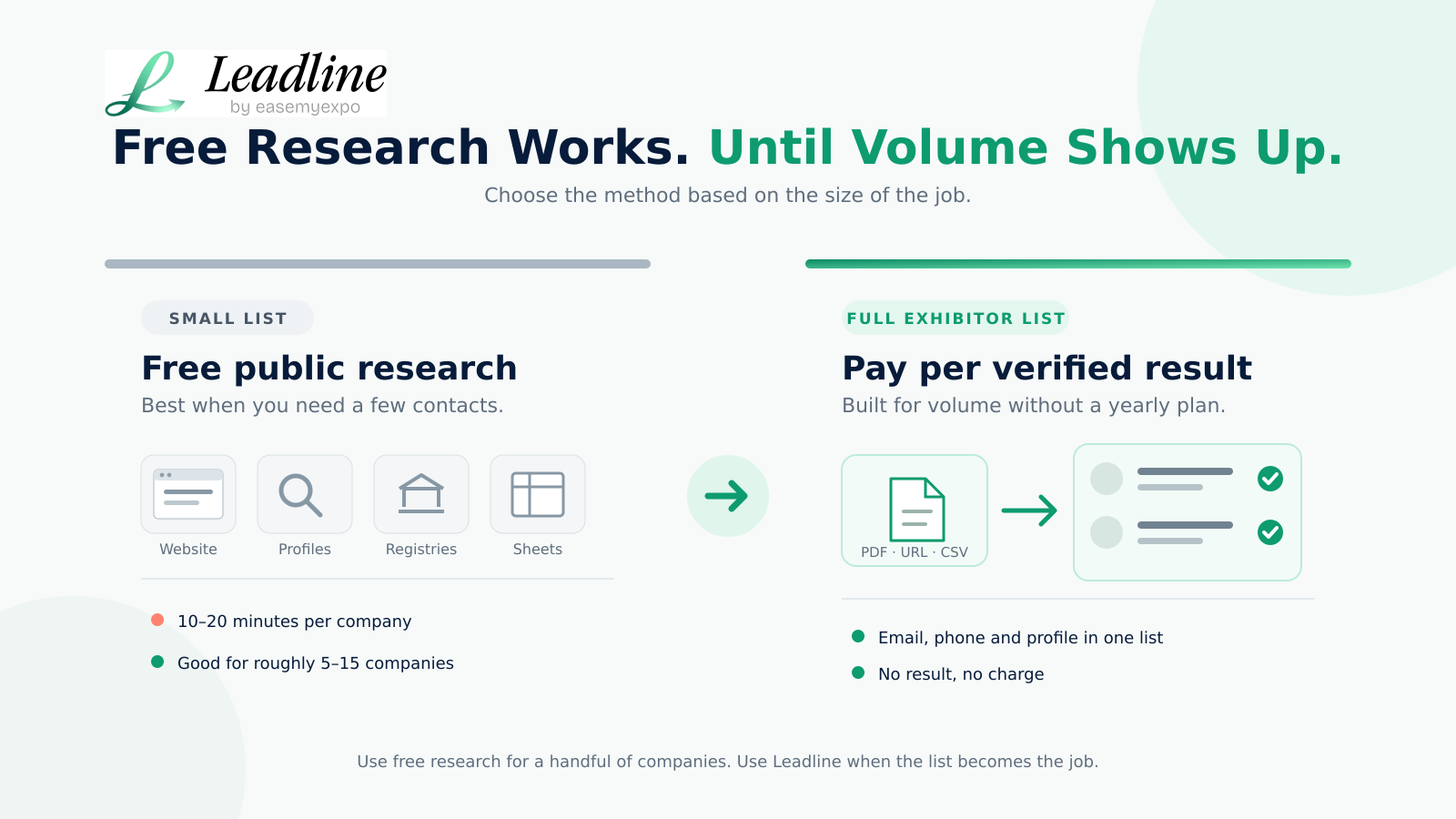
Put these together and you can build a workable list of ten or fifteen companies without spending anything. The limiting factor isn't the method, it's the time. Each company takes ten to twenty minutes of manual digging, one at a time, with no shortcut for volume.
Where free methods stop working
Free research holds up fine until volume shows up.
Fifteen companies by hand is an afternoon well spent. Three hundred companies from a trade show floor plan is a full day of clicking, and that's before a single email has been checked for whether it actually lands.
Format is the other wall. Nobody is manually retyping company names off a scanned floor plan PDF into a LinkedIn search box, one row at a time, for an entire exhibitor hall.
See how a floor plan turns into a contact list
This is really the line between two different problems. Free sources say "I need five contacts." They don't scale to "I need contacts for every company exhibiting at this show," and pretending they do just moves the cost from money to time.
How to find decision-maker contacts without paying for an entire database
Pay-per-result tools change the math here in a specific way. Instead of a year of database access, you pay only for the contacts that come back verified, and nothing for the ones that don't.
Leadline works this way, and it's built around exhibitions specifically rather than general prospecting. Upload a floor plan PDF, paste an exhibitor directory URL, or drop in a spreadsheet of company names from last year's show. It returns each decision-maker's name, work email, direct phone number, and LinkedIn profile, with the email verified against live mail servers before it's handed to you.
Pricing starts at ₹199, and a company that returns no usable contact doesn't cost you anything. That's the structural difference from a subscription: you're not paying to keep a database running in the background, you're paying for a result, only when there is one.
Compare Leadline with ZoomInfo
General databases weren't built to start from a floor plan or scrape a show's exhibitor page. They index profiles that already exist online, which means a scanned PDF or a directory buried on an organiser's site is outside what they were designed to read. That's the specific gap a subscription can't shortcut, no matter how large the database behind it is.
How to verify an email without a paid tool
If you've guessed an email pattern rather than finding it published somewhere, a few free checks help before you send anything real.
Run the address through a free-tier verification tool, most allow a small number of checks per month at no cost. Check the pattern against any email already published on the company's site or in a job listing, then apply that same pattern to the name you found. If you're still unsure, send something low-stakes first, like a calendar invite, rather than your actual pitch.
None of this replaces real-time verification at scale, since a manual check only tells you the pattern looks right, not that the mailbox is currently active. For a short list though, it's usually enough to keep your bounce rate reasonable.
Finding contacts from a trade show exhibitor list specifically
If your list came from a floor plan, an exhibitor directory, or a spreadsheet somebody exported last year, you're actually dealing with a narrower and more solvable problem than general B2B prospecting.
You already know exactly which companies matter. What's missing is the person at each one, and a way to reach them that's verified and fast enough to land before a competitor works through the same list.
Browse upcoming shows in Leadline's calendar
That gap, between owning the exhibitor list and having the decision-maker's number the week before the show opens, is the actual problem worth solving, and it's a different one from "does our company have database access."
Common questions on this
Is it legal to find decision-maker contacts without buying a database?
Yes. Pulling a name from a company's own website, a public filing, or a LinkedIn profile someone has made public is standard business research. What matters more than the source is how relevant your outreach is once you have the email, since that's what compliance rules like GDPR and India's data protection framework actually care about.
Can I find an email without knowing the decision-maker's name first?
Not reliably. Every method here, free or paid, starts from a name. A tool that skips straight to "give me an email for this company" is usually just guessing at a generic address rather than finding the actual person.
What's the fastest way to get contacts for an entire trade show at once?
Manually, it's roughly eight hours per show once you count opening the organiser's PDF, typing every company name into a sheet, and searching each one individually. Leadline was built to remove that specific step, turning the same floor plan into a verified contact list in under five minutes.
Watch how the extraction works
Do free methods work for exhibitor lists too, not just single companies?
Technically yes, but the ten-to-twenty-minutes-per-company math doesn't change just because the companies came from a floor plan instead of a target account list. A 200-company exhibitor list at that rate is a multi-day project, not an afternoon one.
Is a pay-per-result tool cheaper than a database if I only need contacts once a quarter?
Usually, yes. A $15,000-a-year contract only makes sense if you're running searches often enough to justify that annual cost spread across them. If your actual pattern is three or four shows a year, paying per verified contact each time tends to come out lower than carrying a subscription for months you're not using it.
The real question isn't free or paid
It's whether you're solving a research problem or a volume problem. For a handful of companies, free public sources will get you there, and there's no reason to pay for anything at that scale.
For a full exhibitor list, the manual route costs you a day you probably don't have before a show, and a database subscription charges you for a year of access you'll use once. Neither is actually solving for what you need, which is a short, verified list, fast.